 The series of conflicts in the western United States between Native Americans, American settlers, and the United States Army are generally known as the Indian Wars.
 Many of the most well-known of these conflicts occurred during and after the Civil War until the closing of the frontier in about 1890.
Various statistics have been developed concerning the devastation of these wars on the peoples involved. One notable study by Gregory Michno used records dealing with figures "as a direct result of" engagements and concluded that "of the 21,586 total casualties tabulated in this survey, military personnel and civilians accounted for 6,596 (31%), while Indian casualties totaled about 14,990 (69%)."
 for the period of 1850–90. However, Michno says he "used the army's estimates in almost every case" & "the number of casualties in this study are inherently biased toward army estimations". His work includes almost nothing on "Indian war parties", and that "army records are often incomplete"; his work is a "workable" number, not a definitive account of events, since it excluded other figures.
According to Michno, more conflicts with native Americans occurred in the states bordering Mexico than in the interior states. Arizona ranked highest, with 310 known battles fought within the state's boundaries between Americans and the natives. Also, when determining how many deaths resulted from the wars, in each of the American states, Arizona again ranked highest. At least 4,340 people were killed, including both the settlers and the Indians, over twice as many as occurred in Texas, the second highest-ranking state. Most of the deaths in Arizona were caused by the Apache. Michno also says that fifty-one percent of the Indian war battles between 1850 and 1890 took place in Arizona, Texas and New Mexico, as well as thirty-seven percent of the casualties in the county west of the Mississippi River.
 , the Oregon Trail and the Mormon emigration to Utah, as well as by settlement of California and Oregon. Relations between American Immigrants and Native Americans were generally peaceful.
 In the case of the Santa Fe Trail, this was due to the friendly relationship of the Bents of Bent's Fort
 with the Cheyenne and Arapaho, and in the case of the Oregon Trail, to the peace established by the Treaty of Fort Laramie. Signed in 1851 between the United States and the plains Indians and the Indians of the northern Rocky Mountains, the treaty allowed passage by immigrants and the building of roads and the stationing of troops along the Oregon Trail.
The Pike's Peak Gold Rush of 1859 introduced a substantial white population into the Front Range of the Rockies supported by a trading lifeline that crossed the central Great Plains. Advancing settlement following the passage of the Homestead Act and the building of the transcontinental railways
 following the Civil War further destabilized the situation, placing white settlers into direct competition for the land and resources of the Great Plains and the Rocky Mountain West. Further factors included discovery of gold in the Black Hills
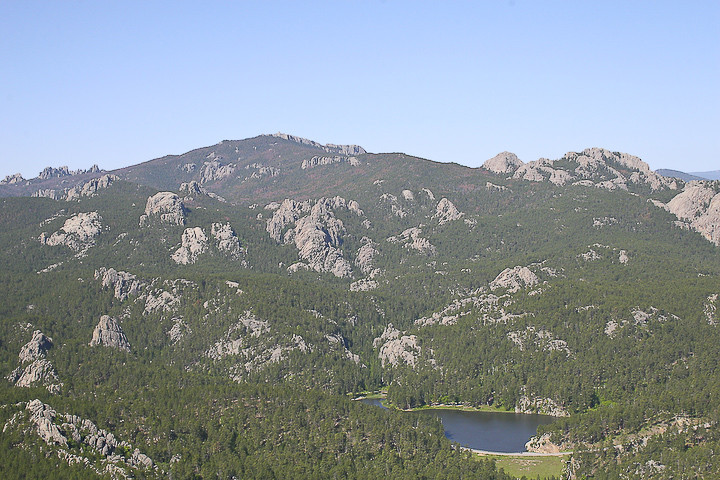 , resulting in the gold rush of 1875–1878, and, earlier, in Montana during the Montana Gold Rush of 1862–1863 and the opening of the Bozeman Trail
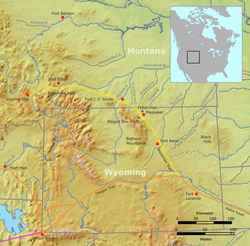 , which led to Red Cloud's War and later the Great Sioux War of 1876–77.
As in the East, expansion into the plains and mountains by miners, ranchers and settlers led to increasing conflicts with the indigenous population of the West. Many tribes-—from the Utes of the Great Basin
 to the Nez Perces
 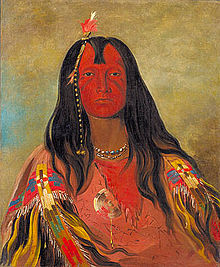 Idaho-—fought Americans at one time or another. But the Sioux of the Northern Plains and the Apache of the Southwest provided the most celebrated opposition to encroachment on tribal lands. Led by resolute, militant leaders, such as Red Cloud and Crazy Horse, the Sioux were skilled at high-speed mounted warfare. The Sioux were relatively new arrivals on the Plains, as, previously, they had been sedentary farmers in the Great Lakes region. Once they learned to capture and ride horses, they moved west, displacing other Indian tribes and became feared warriors. Historically the Apache bands supplemented their economy by raiding others and practiced warfare to avenge a death of a kinsman. The Apache bands were adept at fighting and highly elusive in the environments of desert and canyons.
During the American Civil War U.S. Army units were withdrawn to fight the war in the east. They were replaced by the volunteer infantry and cavalry raised by the states of California and Oregon, by the western territorial governments or the local militias. These units fought the Indians besides keeping open communications with the east, holding the west for the Union and defeating the Confederate attempt to capture the New Mexico Territory.

No comments:
Post a Comment